
A guide for two
How to choose a
baby name together.
You don’t need identical taste to find a name you both love. Start with two honest shortlists, make space for each other’s reasons, and take the decision one conversation at a time.
A baby name can carry family history, a favourite sound, a cultural connection or simply a feeling. When two people bring different hopes to the choice, comparing lists can feel surprisingly personal. This process gives you a way to explore those hopes together. A notebook works just as well as an app.
Start with what matters to each of you
Before swapping names, each choose two or three things you care about. You might want a name that works in both family languages, honours a relative, has an everyday spelling, or feels familiar without being very common.
Separate a firm need from a preference. “We want to keep this family name” is a different starting point from “I usually like short names.” Leave some room to be surprised.
Try asking each other
- What would you like our child’s name to connect them to?
- Which names have you liked for a long time, and why?
- Is there a sound, spelling or association you would find difficult?
Make shortlists separately, then compare
Try collecting five to ten names each before discussing them. Include names you genuinely like, even if they differ from your partner’s usual taste. Add a short note about what appeals to you: the rhythm, a nickname, a memory or its meaning.
When you compare, let each person finish explaining before responding. Sort the suggestions into three groups: names you both like, names to revisit, and names to set aside. A “maybe” can stay a maybe.
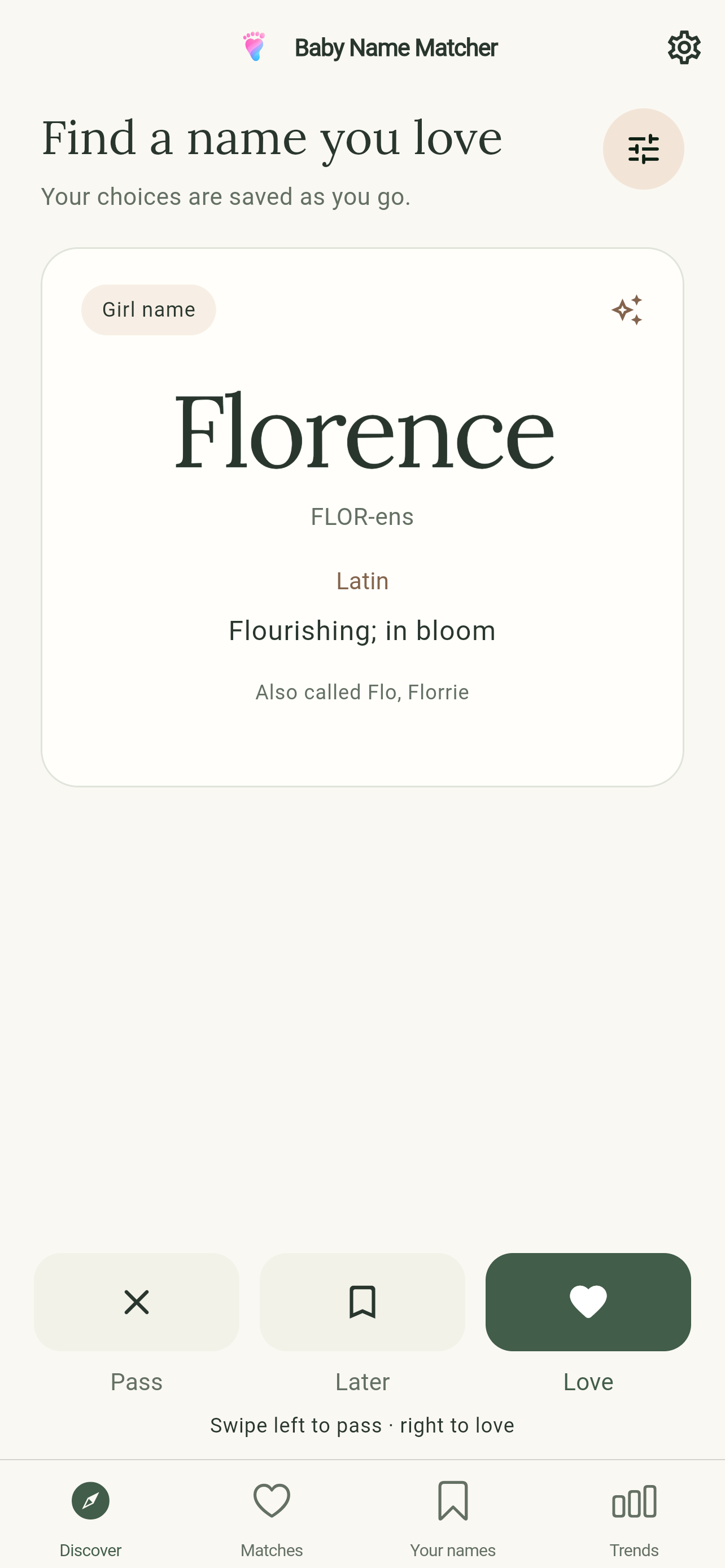
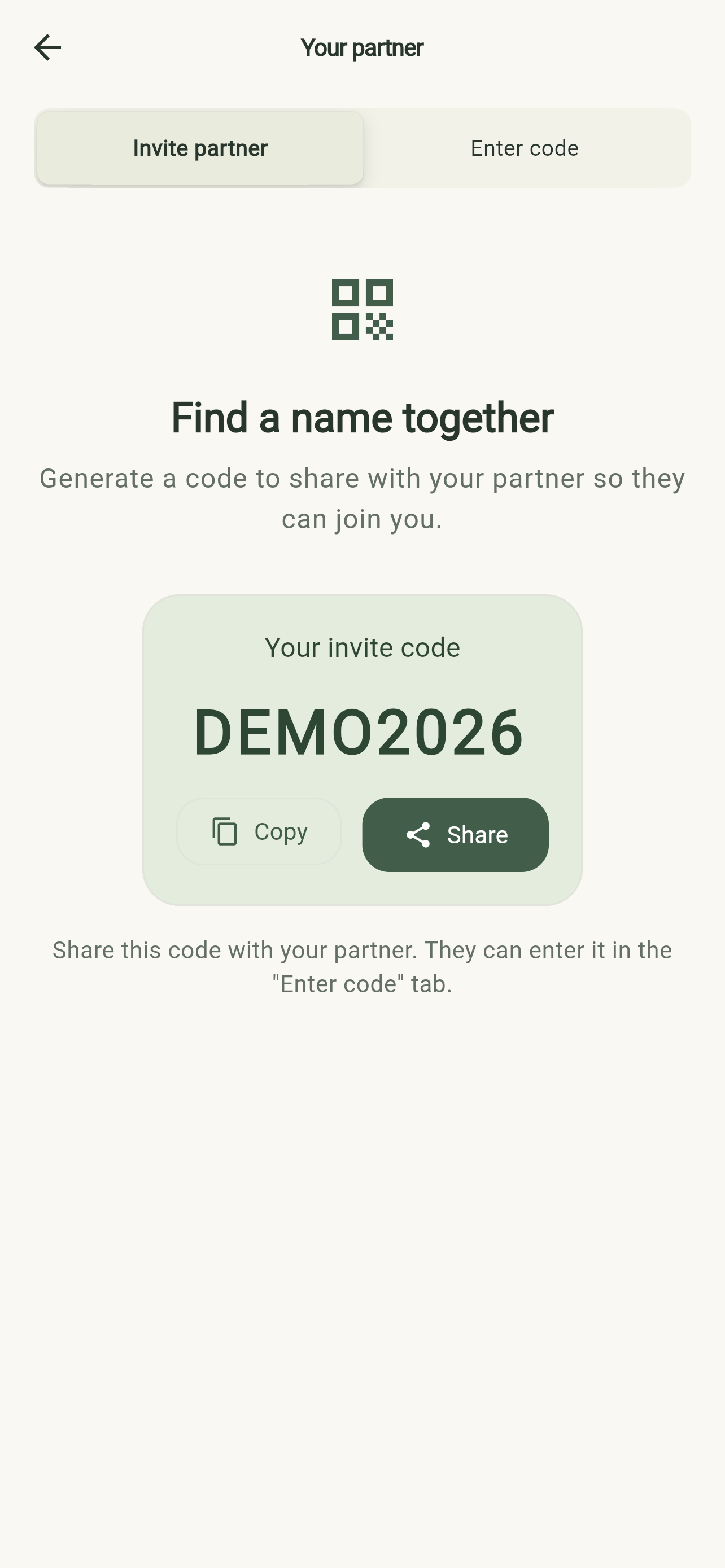
If you use Baby Name Matcher, you can browse separately and choose Love, Pass or Later. Once you link with a private invite code, names you both love appear in Matches. You can add a custom name if a family favourite is missing. Our partner connection guide explains how to link your accounts.
 Open full size
Choose Love for a name you like, Pass to move on, or Later when you want more time. Your partner can explore at their own pace.
 Open full size
Share your private invite code with your partner, who enters it in the Enter code tab. The code shown here is an example.
Look for the reason behind a favourite
If your lists don’t overlap, look for qualities you share. Perhaps one person likes a traditional family name and the other prefers something short. A shorter form, a different name with a similar sound, or a meaningful middle name might give you somewhere new to look.
Explain a hesitation kindly: “I find that pronunciation difficult” gives your partner more to work with than “That’s a terrible name.” Agree that either of you can set a name aside without having to win an argument. If one name keeps causing tension, pause it and return to the qualities you both want.
For example, you could agree to bring three new suggestions to the next conversation, each chosen because it meets one preference from both lists. Aim for a name you both feel comfortable choosing, without keeping score of whose suggestion it was.
 Open full size
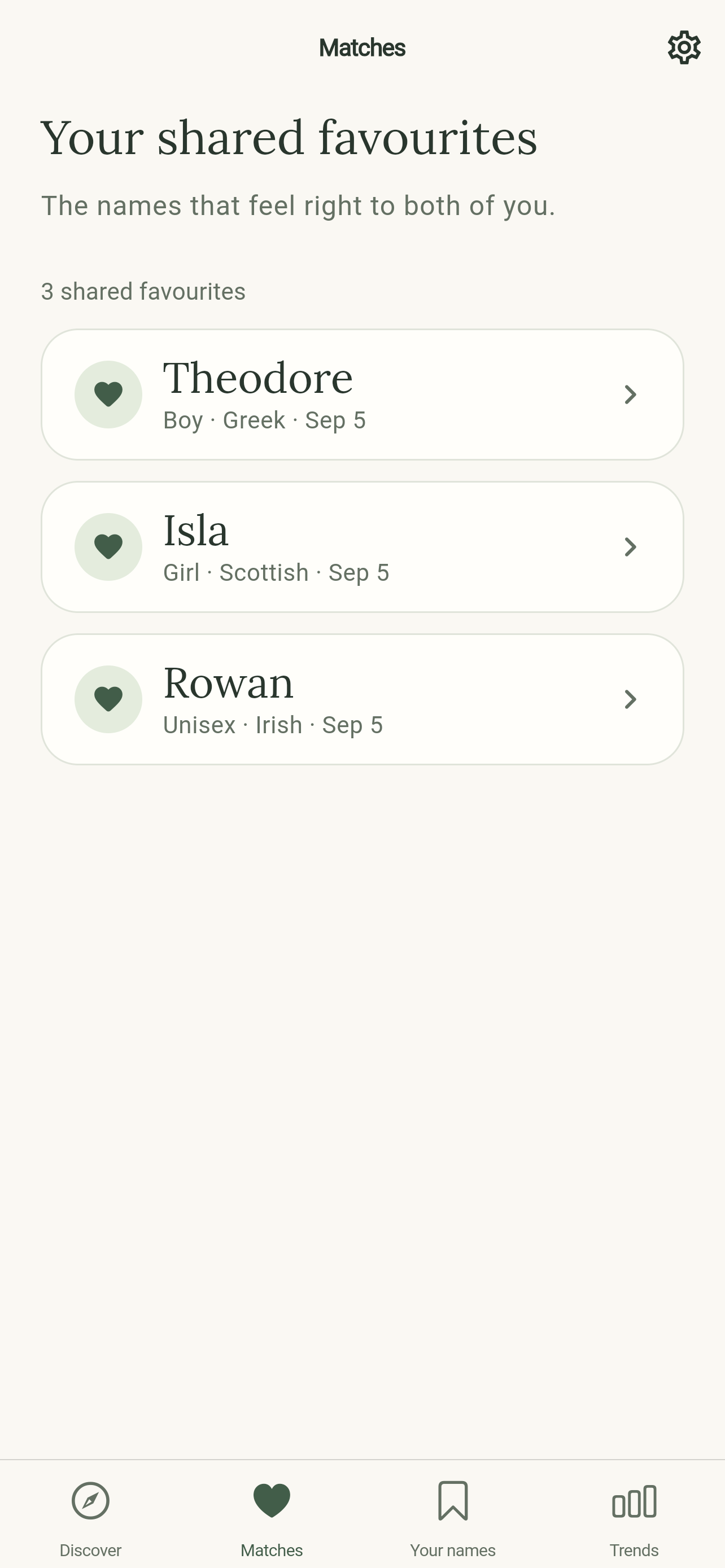
Matches brings together the names you both love. Use these shared favourites as a starting point for your next conversation, then open a name to explore it further.
Try your favourites in everyday life
Take a few shared favourites and say each one with the surname and any middle names. Write the full name, check the initials and try the nicknames you might naturally use. Neither rhythm nor initials need to follow a formula; you’re checking how the name feels to you.
Use ordinary sentences such as “This is our daughter…” or “Would you like to come with us, …?” Try the name gently and out loud, rather than treating it as a test with a right answer.
If your family uses more than one language, try it in each. Ask a trusted speaker about pronunciation or associations when you’re unsure. Decide how much variation you’re comfortable with, including whether you like the full name as well as a favourite nickname.
Check meaning, spelling and popularity
If a meaning or cultural connection is central to your choice, check it with a reliable reference or someone knowledgeable about that language or tradition. Name spellings and origins can have more than one explanation; a short meaning in an app is a starting point for exploring further.
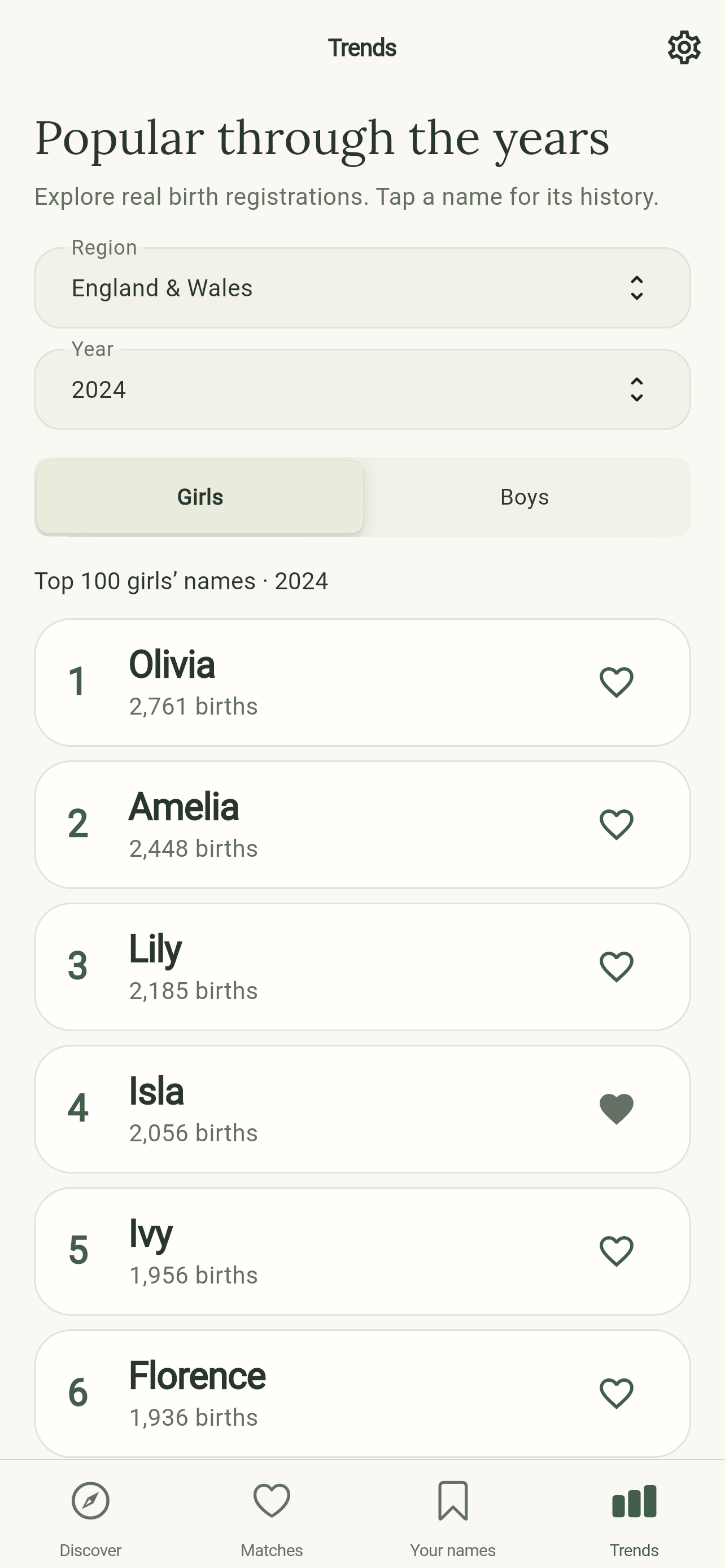
If popularity matters to you, compare names in the same region and year. A ranking for one country does not describe every local community, and a past trend cannot tell you how many children with that name will be in a future class.
Baby Name Matcher includes published trends for England and Wales, Scotland, Northern Ireland and Ireland, with coverage varying by name and year. Our baby-name data sources link to the original statistics and explain gaps in the data. A missing entry does not necessarily mean that no babies received that name.
 Open full size
Choose the same region and year when comparing names. This example shows England and Wales in 2024; tap a name in the app to explore its history.
Give yourselves room to decide
Keep a small shared shortlist and revisit it after a few days. Notice which names you return to naturally. You can use a short, planned conversation to compare how you feel, then put the list away instead of reopening the decision all evening.
Agree together who, if anyone, you want to involve. Asking a relative about a family name can be helpful; inviting everyone to vote can make your own preferences harder to hear. It’s fine to keep the shortlist between you.
If you still have two favourites, keep both for now. You do not have to force a dramatic moment of certainty. The aim is a choice you can both say warmly and feel happy making together.
A final check, together
For each name still on your shortlist, talk through these five questions:
- Do we both like the name, including its full form?
- Have we tried it with the surname, middle names and initials?
- Are we comfortable with the spelling, pronunciation and likely nicknames?
- Have we checked any meaning, family connection or popularity detail that matters to us?
- Would we still choose it without anyone else’s approval?
You can keep notes alongside your shortlist and return to them whenever you need. Leave room for a thoughtful “not sure yet.”